Entertainment Expenses in Korea: The KRW 30,000 Card Rule, and the Ceiling Above It
Korean corporate tax tests client entertainment twice: first on how it was paid, then on how much of it there was. A foreign-owned subsidiary usually fails the first test on receipts and the second on a ceiling it assumed was three times higher.
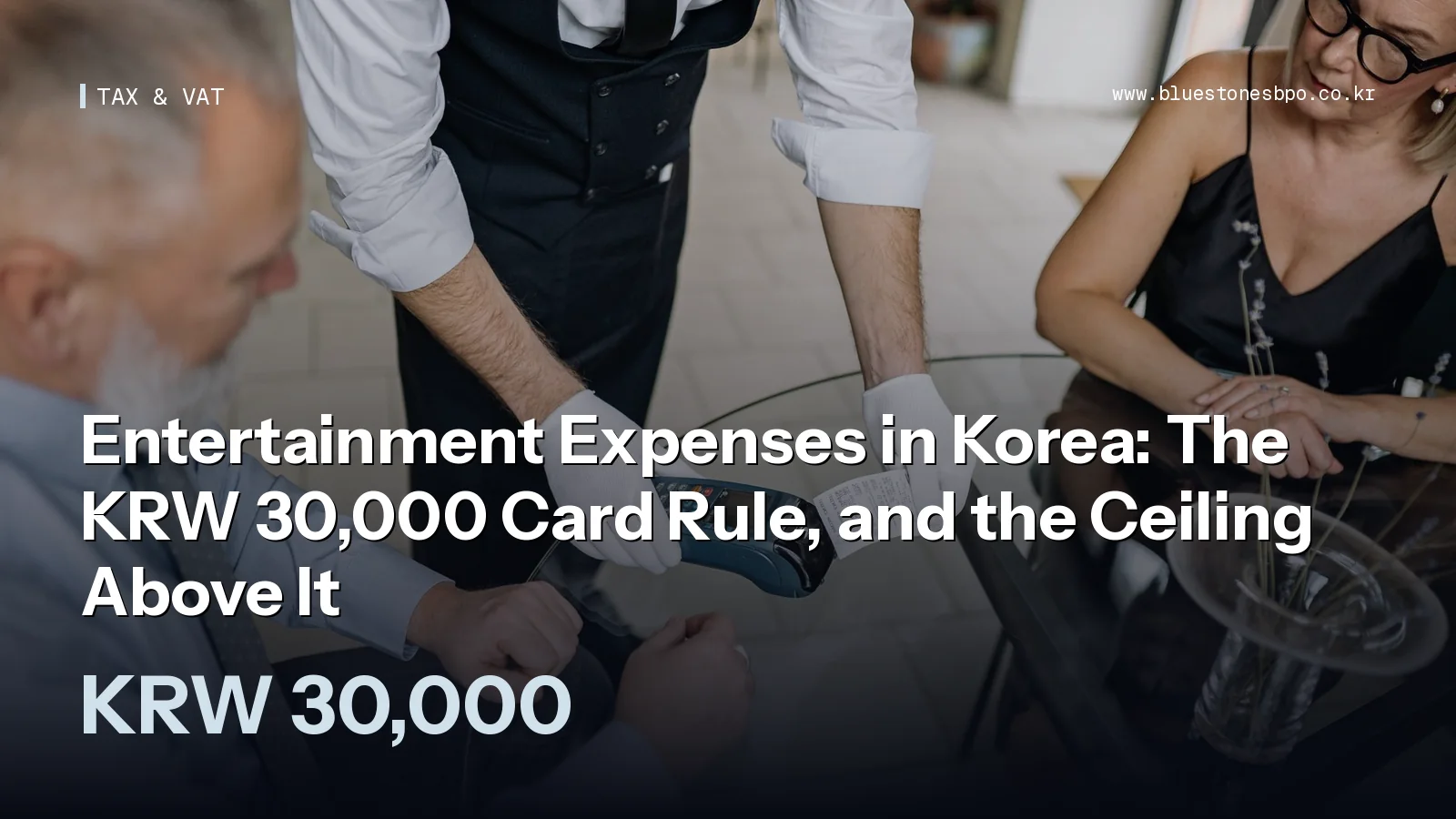
Photograph by Yan Krukau on Pexels.
Korea tests entertainment spending twice, and the first test is about the receipt
Take a Korean subsidiary to a client dinner costing KRW 180,000. Whether that KRW 180,000 reduces taxable income turns on two separate questions, and they are asked in order.
First: how was it paid? If the bill went on a corporate credit card, a cash receipt was issued, or a tax invoice was raised, the expense survives. If it went on someone’s personal card and was reimbursed through expenses, the whole KRW 180,000 is disallowed. Not the excess over KRW 30,000 — all of it.
Second, and only for what survives the first test: was the company’s total entertainment for the year inside its ceiling? The ceiling is a fixed base plus a slice of revenue, and it is smaller than most foreign-owned subsidiaries expect.
Most groups arriving in Korea know there is “a limit”. Very few have looked at which of the two tests is actually costing them money, and it is almost always the first one.
One naming point, because it causes real confusion in translated policy documents. What everyone still calls 접대비 was renamed 기업업무추진비 — “corporate business promotion expenses” — when the heading of Article 25 of the Corporate Tax Act was amended at the end of 2022. English summaries use both terms, sometimes on the same page. They are the same rule.
What counts as entertainment in the first place
Article 25 defines it broadly and deliberately so: amounts spent by a company, directly or indirectly, on people connected to its business, in order to make that business go more smoothly. Entertaining, hospitality, gifts of appreciation — the statute says “by whatever name” and means it.
That breadth is the point. A line item called “client relations”, “business development costs” or “sample gifts” is not outside the rule because of what it is called in the general ledger. The tax office reclassifies by substance, and a reclassification lands twice: the amount joins the entertainment pool for ceiling purposes, and if it was paid on a personal card it is disallowed outright on the evidence test.
The distinction that matters most in practice is between entertainment and advertising. Money spent on people who are identifiable counterparties to the business is entertainment. Money spent on an undifferentiated public — a campaign, a trade show stand, promotional items distributed generally — is advertising, and advertising has no ceiling. Getting an item on the wrong side of that line is one of the more common findings in a Korean corporate tax review.
The evidence test: the corporate card is not a policy preference
The list of acceptable payment evidence in Article 25(2) is closed. It runs to a credit card under the Specialized Credit Finance Business Act, a cash receipt, an invoice or tax invoice, a purchaser-issued invoice, and a prescribed withholding receipt. There is no residual category for “other adequate documentation”.
There is also a trap inside the card rule. Article 25(3) provides that where the sales slip is issued in the name of a merchant other than the one that actually supplied the goods or services, the amount is not treated as card-paid entertainment at all. That is aimed at slip-swapping between affiliated venues, and it means a card receipt is not automatically sufficient — the merchant on the slip has to be the merchant who served you.
The narrow relief is for expenditure where the fact of spending is objectively clear but the prescribed evidence cannot practically be obtained. The statute names expenditure in overseas regions and expenditure with farmers and fishers, and leaves the detail to the Enforcement Decree. This is a rule about places where Korean corporate cards and Korean tax invoices do not exist. It is not a general exemption for spending abroad, and a company treating every overseas dinner as exempt has misread it.
Separately, and more broadly than entertainment, Korean corporate tax requires qualifying payment evidence for any disbursement over KRW 30,000 for goods or services, kept for five years — seven where the transaction was cross-border. Failure to hold it attracts a 2% penalty on the amount, subject to an annual ceiling. The entertainment rule is the sharp end of a general documentation regime, not an isolated quirk.
The ceiling: a base amount, plus a slice of revenue
What survives the evidence test is then tested against an annual limit made of two parts added together.
The base is KRW 12,000,000 for a full twelve-month business year, or KRW 36,000,000 if the company qualifies as an SME for tax purposes, pro-rated by the number of months in the business year divided by twelve. A company incorporated in July with a December year end gets six twelfths of it.
The second part is a percentage of revenue, on a marginal scale.
| Revenue for the business year | Revenue component of the ceiling |
|---|---|
| Up to KRW 10 billion | 0.3% of revenue |
| KRW 10 billion to KRW 50 billion | KRW 30 million + 0.2% of the excess over KRW 10 billion |
| Above KRW 50 billion | KRW 110 million + 0.03% of the excess over KRW 50 billion |
Two adjustments sit on top, and both matter more to a foreign-owned entity than to a domestic one.
Revenue arising from transactions with related parties is counted at 10% of the amount the rate table would otherwise produce. A Korean subsidiary that manufactures or provides services almost entirely for its own group can show KRW 40 billion of revenue and still have a revenue component in the low tens of millions of won. If you have budgeted entertainment against turnover, this is where the arithmetic breaks.
And a company whose principal business is real estate rental, together with others specified by the Enforcement Decree, is capped at 50% of the combined base-plus-revenue figure.
There is one genuine relief worth knowing. Spending on cultural items — books, performance tickets and comparable cultural events — carries an additional allowance, capped at the lower of the cultural spend itself and 20% of the general ceiling. It is not large, but for a company that entertains with concert or exhibition tickets rather than dinners it is real, and it goes unclaimed routinely because nobody codes cultural spending separately in the ledger.
The SME question is where foreign subsidiaries lose most
Three times the base amount is a KRW 24 million difference in deductible expense, so it is worth being precise about who gets it. In practice the KRW 36 million base is claimed on Korean subsidiaries that are not entitled to it, and the mistake usually survives until an audit because the company looks small.
The tax definition of an SME is in Article 2 of the Enforcement Decree of the Restriction of Special Taxation Act, and it has more moving parts than a size test:
- Revenue must be within the sector-specific threshold in the Framework Act on Small and Medium Enterprises.
- Total assets of KRW 500 billion or more disqualify the company outright, whatever its revenue.
- The company must not belong to a disclosure-target business group, and must satisfy a substantive independence test by reference to the Framework Act’s Enforcement Decree.
- Real estate rental and consumptive service businesses are excluded where they are the principal business.
The independence test is the one that catches foreign groups. It looks through the shareholder register rather than stopping at the Korean company’s own balance sheet, and the Decree expressly provides for calculating the total assets of a foreign corporation for the indirect-ownership limb of that test. A Korean entity with thirty staff and modest revenue, majority-owned by a large overseas parent, is being measured against that parent.
If the answer is that the company is not an SME, that is not a reason to spend less. It is a reason to know the number before December rather than in March, when the return is being prepared and nothing can be changed.
What actually goes on the return
The add-back is not an internal adjustment. It is reported on the business promotion expense adjustment schedule — Form No. 23 under Article 82 of the Enforcement Rule of the Corporate Tax Act — which is filed as an attachment to the corporate income tax return alongside the tax adjustment statement.
That has a practical consequence worth stating plainly. The tax office already holds the company’s corporate card and cash receipt data. It sees the schedule showing what the company classified as entertainment, what it treated as evidenced, and what it added back. A subsidiary reporting a large entertainment figure with a small disallowance, on a card trail that does not support it, has published the discrepancy itself.
Getting this right is bookkeeping discipline more than tax planning: the classification has to happen when the expense is booked, not when the return is prepared. That is the same reason the external audit threshold tends to arrive as a surprise — the underlying record either supports the position or it does not, and by filing season it is too late to change how a year of receipts was captured. Our accounting and bookkeeping service codes entertainment against the ceiling through the year, and the tax and VAT compliance service prepares the schedule that goes with the return.
Where this genuinely does not need outsourcing: a company with two employees and a handful of client lunches a year is nowhere near either limit, and a competent local bookkeeper will keep it clean. The rules start to cost money at the point where entertainment is a budget line with an owner, and where a chunk of revenue is intercompany.
The three things to fix first
Entertainment is a small line in most Korean subsidiaries’ accounts and a disproportionate share of their audit adjustments, because the rules test how money was spent rather than whether it should have been.
Move company entertainment onto corporate cards and stop reimbursing personal ones over KRW 30,000. Calculate the ceiling in the first quarter, on the correct base, with related-party revenue haircut applied. And check the SME position against the shareholding rather than assuming it from the size of the office.
Figures current as at 28 August 2026, verified against Article 25 of the Corporate Tax Act (Act No. 21217, in force 1 January 2026) and Article 2 of the Enforcement Decree of the Restriction of Special Taxation Act (Presidential Decree No. 36423, in force 1 July 2026). Korean deduction thresholds are revised most years; confirm the current figure before relying on it. This is general information about how the rules work, not advice on a particular company’s position.
Official portals & tools
The government portals behind this topic. Opens in a new tab.
- Hometax — National Tax Service e-filing portal — Where the corporate income tax return and its schedules are filed, and where corporate card and cash receipt data already sits — the same data the tax office matches against the entertainment figure in the return
- National Tax Service — corporate tax filing guidance — The NTS's own filing pages for corporate income tax, including deadlines and the schedules that attach to the return. Korean interface only
- Korea Ministry of Government Legislation — statute database — The authoritative text of the Corporate Tax Act and its Enforcement Decree. Article 25 is the business promotion expense rule and it is amended more often than the English-language summaries reflect
- Korea Legislation Research Institute — English statutes — Unofficial English translations of the Corporate Tax Act. Useful for a head office reading the provision, but check the effective date on the translation before relying on a figure
- Invest Korea — Taxation in Korea — KOTRA's English tax guidance for foreign-invested companies, including the deduction ceilings. A reasonable orientation document to hand to a parent-company controller
Frequently asked questions
What is the entertainment expense limit in Korea?
For a business year running the full twelve months, the deductible ceiling is KRW 12,000,000 plus a percentage of revenue, and the base rises to KRW 36,000,000 if the company qualifies as a small or medium enterprise for tax purposes. The revenue component is 0.3% of revenue up to KRW 10 billion, KRW 30 million plus 0.2% of the excess between KRW 10 billion and KRW 50 billion, and KRW 110 million plus 0.03% of anything above KRW 50 billion. Revenue billed to related parties is counted at only a tenth of that. Spending above the resulting total is added back to taxable income. These figures are current as at August 2026.
Can I deduct entertainment paid on a personal credit card and reimbursed?
No, not once the single occasion exceeds KRW 30,000. Article 25 of the Corporate Tax Act lists the acceptable payment evidence exhaustively: a credit card under the Specialized Credit Finance Business Act, a cash receipt, a tax invoice or an ordinary invoice, a purchaser-issued invoice, or a prescribed withholding receipt. A personal card slip is none of those, and the fact that the company reimbursed the employee does not repair it. The expense is disallowed in full — not just the excess over KRW 30,000 — and it is disallowed before the annual ceiling is even calculated.
Is a Korean subsidiary of a foreign group an SME for the KRW 36 million base?
Usually not, and this is the most expensive assumption in this area. The tax definition of an SME in Article 2 of the Enforcement Decree of the Restriction of Special Taxation Act is not simply a headcount or a revenue test. A company with total assets of KRW 500 billion or more is excluded outright, the company must not be principally engaged in real estate rental or consumptive service businesses, and it must satisfy a substantive independence test that looks through to its shareholders. That Decree expressly provides for calculating the total assets of a foreign corporation for the indirect-ownership part of that test, so a majority-owned Korean subsidiary of a large overseas parent is measured against the parent’s balance sheet, not its own.
What happens to entertainment spend above the ceiling?
It is added back when computing taxable income for the business year. There is no carry-forward: an amount disallowed this year is gone, and it cannot be used against a year in which the company spent less than its ceiling. The add-back is reported on the business promotion expense schedule that accompanies the corporate income tax return, so it is visible to the tax office on the face of the filing rather than something that only emerges in an audit. A company that budgets entertainment without reference to the ceiling is simply electing to pay corporate tax on part of it.
Do overseas entertainment costs follow the same evidence rule?
There is a narrow carve-out, and it is narrower than most people assume. The Corporate Tax Act relieves the evidence requirement where the fact of the expenditure is objectively clear but the prescribed evidence is impracticable to obtain — expenditure in overseas regions and expenditure with farmers and fishers are the examples named in the statute, with the detail left to the Enforcement Decree. That is a rule about places where corporate cards and Korean tax invoices do not exist, not a general exemption for anything spent abroad. A dinner in a city where the company’s card is accepted normally is not covered, and the ceiling applies to overseas entertainment regardless.
Sources & further reading
Every figure in the key takeaways is numbered to the source it was read from. Sources marked primary are the tax office, ministry, insurance authority or statute itself.
- 1Corporate Tax Act, Article 25 (exclusion of business promotion expenses from deductible expenses) — the definition, the payment-evidence requirement, the base and revenue ceilings, the 10% treatment of related-party revenue and the 50% cap for real estate rental businessesprimary — Ministry of Government Legislation, Korean Law Information Center — Act No. 21217, in force 1 January 2026 · verified 2026-08-28
- 2Enforcement Decree of the Restriction of Special Taxation Act, Article 2 (scope of small and medium enterprises) — the KRW 500 billion total-asset exclusion, the substantive independence test and the calculation of a foreign corporation's total assetsprimary — Ministry of Government Legislation, Korean Law Information Center — Presidential Decree No. 36423, in force 1 July 2026 · verified 2026-08-28
- 3Enforcement Rule of the Corporate Tax Act, Article 82 (forms) — item 23, the business promotion expense adjustment schedule (Form No. 23) filed as an attachment to the corporate income tax returnprimary — Ministry of Government Legislation, Korean Law Information Center — Ministerial Decree No. 7, in force 20 March 2026 · verified 2026-08-28
- 42025 Taxation in Korea (KOTRA Report 25-010) — business promotion expense ceiling: basic ceiling of KRW 12,000,000 (KRW 36,000,000 for SMEs) pro-rated by months, the revenue ceilings, and the cultural spending add-on capped at 20% of the general ceiling — Invest Korea / KOTRA, English tax guide for foreign-invested companies · verified 2026-08-28
- 5Korea, Republic of — Corporate — Deductions: the KRW 30,000 and KRW 200,000 evidence thresholds for corporate business promotion expenses, the revenue-band ceiling table, the general KRW 30,000 documentation rule and the 2% evidence penalty — PwC Worldwide Tax Summaries, page last reviewed 4 June 2026 · verified 2026-08-28
How we help with this
Accounting & Bookkeeping
Statutory books kept in Korean for the tax office, and a management pack in your group's format and language for the people who make decisions. One team does both, so the two never disagree.
- Statutory books maintained under Korean GAAP or K-IFRS
- Monthly close with a fixed calendar you can plan around
- Head-office reporting pack in your group's format
- Audit support and auditor liaison when thresholds are met
Tax & VAT
The Korean filing calendar, handled end to end: VAT returns, the corporate income tax return, withholding on payments to your parent, and the transfer pricing file that supports them.
- VAT returns filed on the statutory quarterly cycle
- Corporate income tax return and interim return
- Withholding and treaty relief on cross-border payments
- Transfer pricing documentation for related-party dealings
Read next
Paying Your Foreign Parent from Korea: 22% by Default, and a New Filing From 2026
A Korean subsidiary paying a dividend, interest or a royalty to its parent withholds 22% unless the parent's treaty documents are in the payer's hands before the payment. From 1 January 2026 holding them is no longer enough — the payer has to file them with the tax office too.
Korean VAT for a Foreign-Owned Company: Four Filings a Year, and What Kills Input VAT
A Korean corporation files VAT four times a year, not twice, and the next deadline is 26 October 2026. The rate is the easy part — what costs foreign-owned companies money is input VAT that was never recoverable and zero-rating on parent-company invoices that does not hold.
Korea's Corporate Tax Interim Payment Is Due 31 August — and the Rate Went Up
Every Korean company with a December year-end owes an interim corporate tax payment by 31 August 2026. This is the first interim payment computed at the restored 10/20/22/25% rates, and the choice between the two calculation methods is worth real money this year.