Korea's Minimum Wage Rises to 10,700 Won in 2027: What Employers Must Do Before 1 January
The Ministry of Employment and Labor gazetted the 2027 minimum wage on 5 August 2026: 10,700 won an hour, 2,236,300 won a month. Here is what it costs a foreign-owned employer, which pay elements count toward the floor, and the obligation that falls due before the year ends.
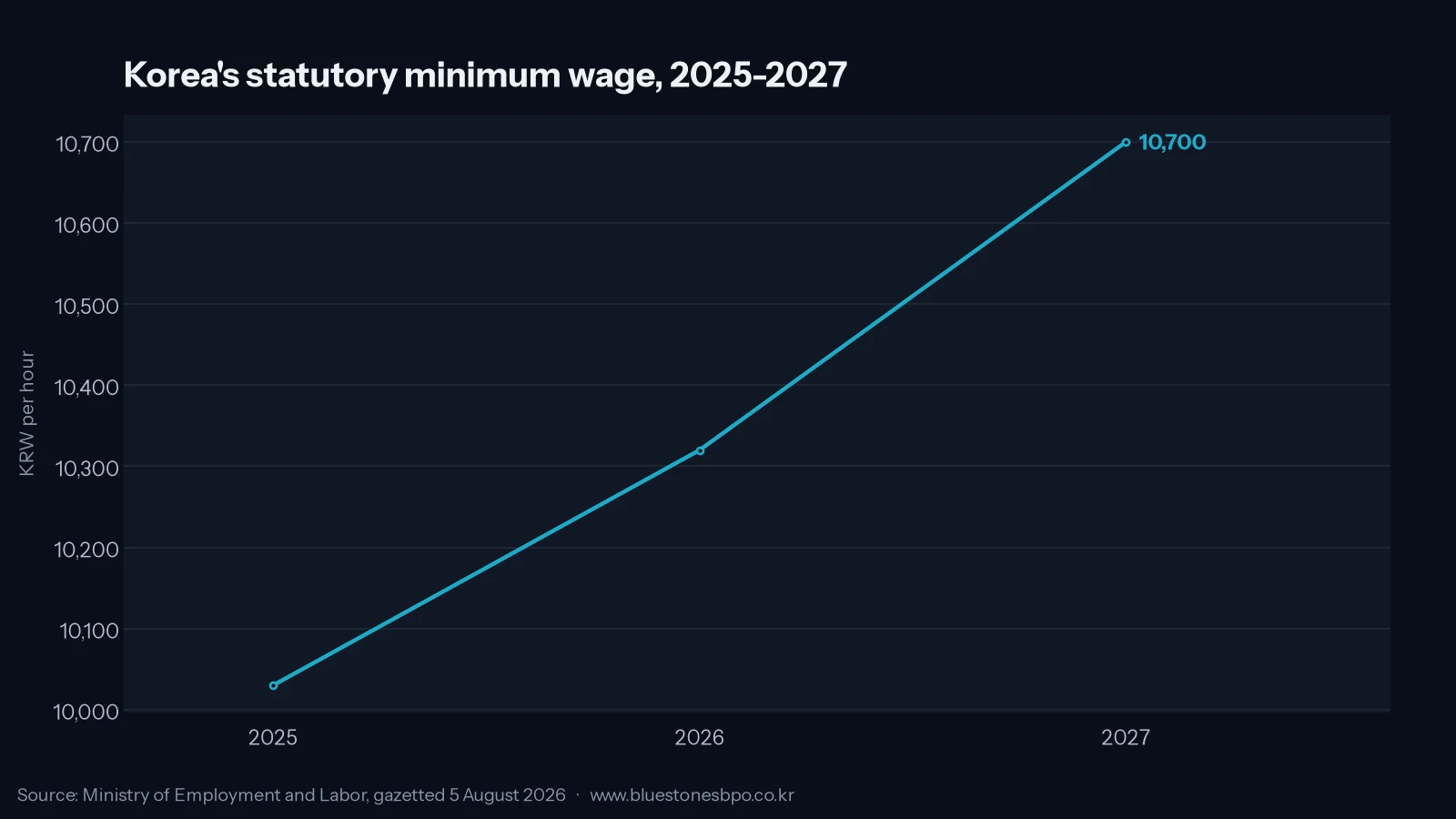
Korea’s minimum wage will be 10,700 won an hour from 1 January 2027
The Ministry of Employment and Labor gazetted the 2027 minimum wage on 5 August 2026 at 10,700 won an hour. That is 380 won more than the 10,320 won in force through the end of this year — a rise of 3.7%. The published monthly equivalent for a full-time employee is 2,236,300 won, and the rate applies uniformly: no industry carve-outs, no regional variation, no separate figure for piece-rate workers.
The Minimum Wage Commission reached the number on 14 July 2026 after an eight-hour plenary session, with the employers’ proposal of 10,700 won carrying the final vote 17 to 11 against the workers’ 10,730 won. Objections were lodged during the statutory comment window by the Korean Confederation of Trade Unions and by the Korea Federation of Micro Enterprise; neither was accepted, and the deliberated figure was gazetted unchanged.
For most foreign-owned entities in Korea the headline is not the interesting part. Almost no foreign subsidiary is paying professional staff at the statutory floor. What the annual revision actually does is reset three things that are easy to get wrong: the arithmetic of which pay elements count toward the floor, the treatment of probationers, and a notice obligation that falls due before the year ends.
What does the increase cost per employee?
Take an employee on a standard 40-hour week paid exactly at the floor. The monthly conversion published by the ministry uses 209 hours — 40 contractual hours a week plus the eight-hour weekly paid holiday entitlement, annualised across a 4.345-week average month.
| Year | Hourly | Monthly (209 hours) | Change on prior year |
|---|---|---|---|
| 2025 | 10,030 won | 2,096,270 won | — |
| 2026 | 10,320 won | 2,156,880 won | +290 won/hour (+2.9%) |
| 2027 | 10,700 won | 2,236,300 won | +380 won/hour (+3.7%) |
The gross monthly step from 2026 to 2027 is 79,420 won per full-time employee at the floor, or 953,040 won across the year. The true cost is higher than that. The employer’s share of the four major insurances is levied on the increased remuneration, and where the increase feeds ordinary wage it also lifts overtime, night-work and holiday premiums, all of which are calculated from it. If a meaningful share of your headcount sits at or near the minimum — warehouse, retail floor, contact centre, kitchen — model the loaded increase rather than the headline percentage.
Which pay elements actually count toward the minimum?
This is where compliance is won or lost, and it is the part that has changed most in recent years. The test is not “what do we pay them in total”. It is whether each element falls inside the definition of wage used for minimum wage purposes.
| Counts toward the minimum | Does not count |
|---|---|
| Base pay for contractual working hours | Anything not paid in currency |
| Regular bonuses paid monthly | Bonuses paid quarterly or annually |
| Cash welfare allowances — meal, transport, accommodation | Payment for hours outside contractual working hours |
| Fixed allowances tied to contractual hours | Overtime, night and holiday premiums |
The phased reform that began in 2019 has finished. In its early years only the portion of a monthly bonus above 5% of the monthly conversion, and the portion of cash welfare allowances above 1%, could be counted; the excluded slices shrank each year and reached zero in 2024. From 2024 onward the whole of a regularly-paid monthly bonus and the whole of cash welfare allowances count.
Two practical consequences follow. First, if your Korean payroll file still applies an exclusion percentage inherited from a template written in 2020 or 2021, it is understating your compliance position and may be triggering top-ups you do not owe. Second, periodicity now matters more than label. A bonus of the same annual value counts in full if it is paid monthly and not at all if it is paid quarterly — and converting a longer-cycle bonus to a monthly one by amending the rules of employment requires the employer to hear the opinion of the trade union or of a majority of employees first. It is not a unilateral payroll change.
Who is covered — and are foreign employees included?
The Minimum Wage Act applies to all businesses and workplaces employing one or more employees. Coverage runs to workers as defined in the Labor Standards Act regardless of employment status or nationality: temporary, daily and part-time employees and foreign employees are expressly within scope.
For a foreign-invested company this matters in two situations that come up repeatedly. An intern or trainee performing work under direction is an employee, whatever the arrangement is called internally, and the floor applies. And an employee seconded into the Korean entity but paid partly from an overseas payroll is still assessed against Korean law on the employment relationship with the Korean entity — the location of the paying bank account does not move the analysis.
The one genuine relief is narrow. Where the employment contract runs for one year or longer, an employer may pay 90% of the minimum during the first three months of a probation period — 9,630 won an hour in 2027. Occupations classified as simple labour and publicly notified by the Minister of Employment and Labor are excluded from the reduction altogether. A fixed-term contract of less than a year does not qualify at all, which means the familiar “six-month trial at a lower rate” structure is not available in Korea.
What happens if you get it wrong?
Two mechanisms operate at once, and the first is the more expensive.
A contract term providing for less than the minimum is void as to that term, and the parties are deemed to have agreed on the minimum instead. There is no negotiation and no defence based on the employee having accepted the rate: the shortfall is simply owed, for as long as it ran.
On top of that, an employer who fails to pay at least the minimum is liable to imprisonment with labour for up to three years or a fine of up to 20 million won, and both may be imposed concurrently. The separate duty to inform employees of the applicable minimum wage — by posting it conspicuously or by another appropriate means, by the day before it takes effect — carries an administrative fine of up to 1 million won if missed.
None of this is exotic enforcement. Underpayment claims are among the most straightforward an employee can bring, they are filed through the ministry’s civil-affairs portal, and a labour inspector examining one file will look at the whole payroll while they are there.
What to do before the year ends
The work is small if it is done in November and awkward if it is done in January alongside year-end settlement and the January payroll run.
Employers who are also working through the retirement-benefit side of the same payroll should read our note on whether severance is owed when an employee resigns, which turns on a different statute but bites the same monthly close.
Figures current as at 14 August 2026. The 2027 rate was gazetted by the Ministry of Employment and Labor on 5 August 2026 and takes effect on 1 January 2027; each figure above is linked to the authority it was read from. This note describes how the rules operate in general and is not advice on any particular employment arrangement.
Official portals & tools
The government portals behind this topic. Opens in a new tab.
- Minimum Wage Commission — Minimum Wage System (English) — The statutory body's own English explanation of who the floor covers and how it is set
- Minimum Wage Commission — obligations of employers (English) — The payment duty, the posting duty and the penalties attached to each
- Ministry of Employment and Labor — Labor Standards (English) — The ministry that gazettes the rate and inspects for compliance
- Labor Laws in Korea (Invest KOREA / KOTRA) — English handbook covering probation, ordinary wage and the 209-hour conversion
- MOEL civil-affairs portal (민원마당) — Where an underpayment complaint is filed, and where employers respond to one
Frequently asked questions
What is the minimum wage in Korea in 2027?
10,700 won per hour, applying from 1 January 2027 to 31 December 2027. The Ministry of Employment and Labor gazetted the figure on 5 August 2026. The published monthly equivalent is 2,236,300 won for a full-time employee working 40 contractual hours a week, on the standard 209-hour conversion. There is no variation by industry, region or company size, and no separate rate for piece-rate workers.
How much more will 2027 cost me per employee?
For an employee currently paid exactly the 2026 floor on a full-time schedule, base pay rises from 2,156,880 won a month to 2,236,300 won — 79,420 won more per month, or 953,040 won over the year. That is before the employer’s share of the four major insurances, which is charged on the higher figure, and before any knock-on effect on overtime and holiday premiums, which are calculated from ordinary wage. Budget the gross increase at meaningfully more than the headline 3.7% if a material part of your headcount sits at or near the floor.
Which parts of the pay package count toward the Korean minimum wage?
Wages paid in currency for contractual working hours count. Wages not paid in currency, and wages paid for hours outside the contractual working hours, do not. Regularly-paid monthly bonuses and cash welfare allowances such as meal, accommodation and transport money now count in full: the phased inclusion that ran from 2019 finished, and from 2024 there is no excluded slice of either. A bonus paid quarterly rather than monthly still falls outside, which is the distinction most foreign employers miss.
Does the Korean minimum wage apply to foreign employees?
Yes. The Minimum Wage Act applies to all businesses and workplaces with one employee or more, and covers workers as defined in the Labor Standards Act regardless of employment status or nationality. Temporary, daily and part-time employees and foreign employees are all expressly included. Visa category does not change the analysis, and neither does the fact that an employee is paid from an overseas payroll if the employment relationship is with the Korean entity.
Can I pay less during a probation period?
Only in a narrow case. Where the employment contract runs for one year or longer, an employer may pay 90% of the minimum during the first three months of a probation period — 9,630 won an hour in 2027. Simple-labour occupations publicly notified by the Minister of Employment and Labor are excluded from the reduction entirely. A fixed-term contract of under a year does not qualify, so the common arrangement of a six-month trial contract at a discounted rate is not available.
What do I have to tell employees, and by when?
An employer to whom the minimum wage applies must notify employees of the applicable minimum wage by posting it in a conspicuous place or by another appropriate means, by the day before it takes effect — so by 31 December 2026 for the 2027 rate. Failure to do so carries an administrative fine of up to 1 million won. It is a small penalty and an easy thing to forget, and it is the item a labour inspector can confirm in seconds.
Sources & further reading
Every figure in the key takeaways is numbered to the source it was read from. Sources marked primary are the tax office, ministry, insurance authority or statute itself.
- 12027년도 적용 최저임금 시간급 10,700원 — Ministry of Employment and Labor press release, 5 August 2026primary — Ministry of Employment and Labor (Labor Standards Policy Division) · verified 2026-08-14
- 2Minimum Wage System — scope of applicationprimary — Minimum Wage Commission, Republic of Korea · verified 2026-08-14
- 3Minimum Wage System — obligations of employers and penalty provisionsprimary — Minimum Wage Commission, Republic of Korea · verified 2026-08-14
- 4Minimum Wage System — wage elements counted for calculating minimum wage ratesprimary — Minimum Wage Commission, Republic of Korea · verified 2026-08-14
- 5Labor Laws in Korea 2025 (KOTRA 25-013) — minimum wage system, probation and the 209-hour monthly conversionprimary — Invest KOREA / KOTRA · verified 2026-08-14
- 6S. Korea sets 2027 minimum wage at 10,700 won per hour, up 3.7% — The Korea Herald, July 2026 · verified 2026-08-14
How we help with this
Payroll & HR
Monthly payroll, the four major insurances, withholding and year-end settlement — calculated in Korea, reported in English, and reconciled into your accounts rather than sitting in a separate system.
- Monthly gross-to-net with a confidential payslip run
- Four major insurances registered, reported and reconciled
- Severance liability tracked, not discovered at exit
- February year-end settlement handled for every employee
Read next

Chuseok Falls Over a Saturday This Year — and Korean Law Gives Nothing Back
Four of Korea's 2026 public holidays land on a Saturday. Two of them buy a Monday back and two vanish, and the difference is written into a presidential decree that most foreign-owned payrolls have never read.
Korea's Spousal Leave Rules Change on 18 September — What Payroll Has to Do Before Then
Three changes to Korean parental leave take effect on 18 September 2026, and a fourth already did on 20 August. Each one moves a date your payroll calendar depends on, and one of them creates a leave entitlement that did not exist before.
Which Foreign Employees Can Skip Korean National Pension — and the Form That Proves It
A foreign employee in Korea is compulsorily insured on the same terms as a Korean national. There are three ways out of that, only one of them is available to a typical assignee, and none of them applies itself.